
Paris World War 2 Sites for History Lovers
Paris is rich in layers of history, and many sites relate to World War 2. History buffs will want to know where to find these various places that are scattered around the city.
During WWII, Paris was occupied by Nazi Germany from 1940 to 1944, and the city played a significant role in the war. You just have to know where to look to see echoes of the war.
The outside walls of the Hotel de Ville still sport marks of bullets that flew around during the Liberation. Signs of the war are in plain sight among the elegant beauty of Paris. The upscale Hotel Meurice served as the Nazi general’s headquarters. The Police Headquarters across the street from Sainte-Chapelle, was the scene of fierce fighting in August 1944 and also still shows bullet impacts.
Here are some key Paris World War 2 sites for history lovers. Some are major tourist draws and others are more obscure. Enjoy knowing more about what happened during the war here and have fun searching out these spots!
The Eiffel Tower
During the war, the French Resistance famously cut the cables of the elevator to prevent the Nazis from using it.
The French tricolor flag was raised on the Eiffel Tower on August 25, 1944, after the Germans surrendered, marking the liberation of the city. This iconic image symbolized the end of German occupation and the return of French sovereignty over the capital. 
The Arc de Triomphe
A symbol of French nationalism, the Arc de Triomphe was occupied by the Nazis during World War 2. It was used by the Germans as a symbol of their control over the city. German soldiers marched under the arch as a sign of their victory, and Nazi flags were displayed there.
The Nazis organized parades and ceremonies around the Arc de Triomphe to showcase their dominance over the city.
As the French Resistance and Allied forces advanced on the city in August 1944, the arch was a focal point for military action. Intense battles raged in this area.
The Allies proved victorious and the Germans fled. On August 25, 1944, General Charles de Gaulle led a victory parade down the Champs-Élysées, culminating at the Arc de Triomphe, to celebrate the liberation of Paris. It was a symbol of the French people’s freedom and resistance against the German occupation.
The Invalides
The tall, glittering gold dome that crowns the Invalides is a landmark in the center of Paris. The Eiffel Tower in the distance rises behind a front yard that’s filled with shrubs and cannon. This complex contains Napoleon Bonaparte’s tomb, artillery pieces, changing exhibits, and the Musée de l’Armée (Army Museum). Here you can explore military history, including WWII exhibits. The World War II collection includes maps, period photographs, a US Army soldier’s vest, and weaponry.
During World War II, Les Invalides, like many significant locations in Paris, was occupied by the German military. The Germans used some parts of the complex for their administrative purposes.
The Invalides also was connected to the French Resistance movement in various ways. One tour guide said Resistance members met high inside the gold dome, right over the heads of the unaware Germans below. It was also the site of several actions during the liberation of Paris in 1944, as the Resistance played a crucial role in the city’s freedom.
After the war, Les Invalides was a site for commemorations, ceremonies, and events honoring the French soldiers who fought in WWII and paying tribute to the fallen.
An excellent permanent exhibition on both World War 1 and World War 2 takes you chronologically through each war. Memorabilia, posters, and artifacts are on display.

The Museum of the Order of Liberation, located in the Invalides, tells the story of the Resistance during World War II.
 Your entry ticket includes all exhibitions of the Invalides, including the Liberation exhibit. See the website for more information.
The Museum of the Liberation of Paris
This new WW2 museum is a must-see for history buffs. Also known as the Museum of the Liberation of Paris, General Leclerc Museum, and Jean Moulin Museum, it is dedicated to the liberation of Paris and the French Resistance. It’s housed in a mansion that served as the actual headquarters of General Leclerc during the liberation of Paris.
Located in the Montparnasse area, the Museum of the Liberation of Paris gives a comprehensive look at this crucial period in Parisian and French history. The museum houses a wide range of historical artifacts, including photographs, documents, weapons, uniforms, and personal items from the World War II era. These items provide a tangible connection to the events of the time.
General Leclerc’s office is here, and you can visit is as you tour. The museum is also dedicated to Jean Moulin, a key figure in the French Resistance. You can explore an exhibit focusing on his life, work, and contributions to the Resistance.
You’ll find interactive displays and multimedia presentations that help visitors better understand the historical context, the strategies of the Resistance, and the events leading up to the liberation of Paris.
The beautiful red, white, and blue décor and lots of light coming in enhance your experience. And information is in both French and English. Allow at least two hours to wind your way through the chronological presentation.
The Shoah Memorial Museum
In the heart of the Marais district of Paris, the Shoah Memorial Museum pays tribute to Jews who lost their lives in the Holocaust during WWII. It also provides personal stories of those who suffered.
The history of the Holocaust is presented on windows and panels and at interactive stations. You can watch short films and study documents. As you learn the stories of people caught up in the Holocaust, you can reflect on their experiences. The museum’s purpose is to inspire people to fight intolerance of all kinds in the present.
Commemorative plaques
Paris buildings display many small commemorative plaques and memorials dedicated to World War II and the liberation of Paris in August 1944. More than 200 plaques are located throughout the city. Some are in rows, but many stand alone in random locations. At times, the government decorates the plaques with small bouquets, which make them easier to spot.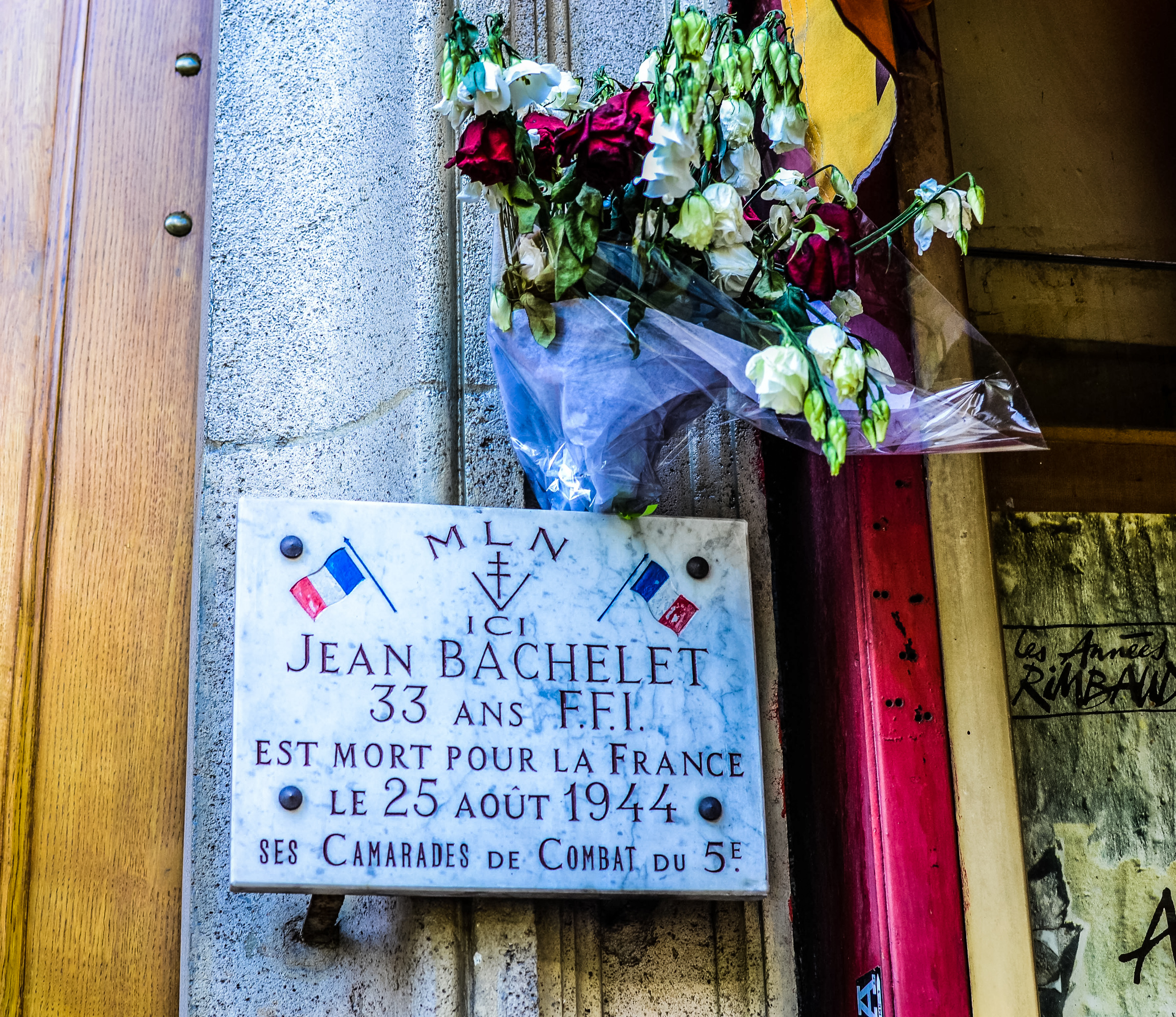
The Liberation of Paris suffered casualties of more than 500 civilians and about 1,000 French Forces of the Interior (FFI), which represented different Resistance movements. French, American and British soldiers also joined the battle. The sporadic street fighting claimed not only Resistance members and soldiers but also ambulance drivers, nurses, and police.
To read more about the commemorate plaques, visit the France24 website, which also provides a detailed map so you can set about looking for the plaques.
The Vel d’Hiv Memorial
A large memorial plaque stands where Vélodrome d’Hiver was located. This sports arena was also known as the Vél d’Hiv. Here the French police, at the instructions of the Germans, rounded up Jews of all ages in July 1942. More than 13,000 Jews were arrested and brought to the velodrome.
The round-up was a first because not only men but also women and children were caught up in the sweep. From here these Jews were moved to the transit camp at Drancy and then by train to Auschwitz.
You can find the memorial plaque at 8 Boulevard de Grenelle. There is also a commemorative sculpture of the round-up near the river.
The Paris Pantheon
The Paris Pantheon, located in the Latin Quarter, serves as a mausoleum containing the remains of distinguished French citizens. The role of this Paris landmark during World War II was more symbolic than practical. It served as a reminder of the French people’s determination to preserve their cultural and historical identity, even in the face of occupation.
Public events and speeches held at the Pantheon rallied support for the Resistance during the war. After the liberation of Paris in 1944, the Panthéon hosted a ceremony where General Charles de Gaulle honored the memory of those who had fought and died in the French Resistance.
The American Library in Paris
The American Library in Paris opened in 1920 and was immediately a popular hub for readers and researchers. The library staff faced hard decisions when war broke out and France was occupied in 1940. Director Dorothy Reeder chose to keep the library open. She stated her view that the library “stands as a symbol of freedom and understanding, of service to all, a fine piece of democracy.”
Through the war, people came to check out books, including Jewish people, who were forbidden by law to do so. Due to the chaos in France, many folks were not able to return borrowed books. Reeder didn’t hesitate to keep on lending books anyway.
Today, The American Library in Paris provides a peaceful place where you are welcome to wander among the stacks of books, sit in a soft chair and read, and marvel that this library survived WW2 and is still going strong today.
The library, moved from its original location at 10 Rue de L’Elysee, is at 10 Rue du Général Camou, near the Eiffel Tower in the 7th arrondissement.
And you may be inspired to read the excellent novel of the war years, The Paris Library by Janet Skeslien Charles.
The Jeu de Paume Library
This unassuming library tucked into the Tuileries is easy to pass by without realizing the role it played during WWII. You may be familiar with the story if you have seen the movie The Monuments Men.
Here, a hero named Rose Valland served as art historian and curator during the Nazi occupation of Paris. Hundreds of pieces of art circulated through the Jeu de Paume before being shipped to Germany for Nazi gain. Art taken from Jews ended up here, marked as “abandoned.”
It’s notable that Reichsmarschall Hermann Göring used the Jeu de Paume as his personal collecting center.
Valland, a volunteer curator, decided to try to save as much art as possible. She kept detailed records of art that passed through. She noted which trains carried various treasures. After the war, this list was instrumental in returning many valuables to the rightful family owners.
Today, this library is an art center that holds exhibitions, classes, and workshops. You can enter the building, and then make your way downstairs to the bookshop. You will be standing in a place where crucial spying took place during World War 2.
To learn more about stolen and recovered art during WWII, read The Monuments Men: Allied Heroes, Nazi Thieves, and the Greatest Treasure Hunt in History by Robert M. Edsel.
Consider a Walking Tour
Enrich your time in Paris and expand your knowledge with a walking tour. I went on an excellent Context Travel tour on the WWII Nazi occupation in Paris. The tour starts near the Eiffel Tower, includes the Marais District, and ends at the Tuileries near the Louvre. You will cover a lot of ground in three hours and be fascinated by all the stories of the Resistance.
I also highly recommend a tour on WWII in Paris with Discover Walks. This tour focuses on the Marais District. You will learn so much in the 2.5-hour time with your guide.
Final thoughts
And to you who would like to follow a family member’s WWII steps, if your loved one was in Paris during the war years, these places may give you a good starting point. My own father enjoyed leave in Paris during his service, as so Allied troops did. Here’s a photo of my dad and his buddies touring Versailles.
Paris offers so many fascinating World War 2 sites for history lovers. Before you go, read up on what you want to visit. Plan your time. Perhaps book a walking tour. Then take in all the historical richness of lovely Paris. You will always remember these places! Hi there! This post may contain affiliate links. That means I earn a bit of money if you purchase products through me. This involves no extra cost to you and it helps me maintain this blog.
Where to stay
Paris offers hundreds of hotels. It’s sometimes overwhelming to start looking for a place to stay. Here are a few suggestions for lovely hotels near some of the sites mentioned. With the excellent Paris Metro system, you will be able to arrive wherever you like with just a little planning.
Near the Invalides: The Hotel de Varenne is exquisitely decorated and includes an inviting patio. You can walk from here to the Invalides as well as the Rodin Museum. (7th arrondissement)
Book your stay at the elegant Hotel de Varenne around the corner from the Rodin Museum.
Near the Pantheon: Hotel des Grand Hommes and (right next door) the Hotel les Dames du Pantheon. Both of these elegant hotels are across the street from the Pantheon. From my balcony room at the Grand Hommes I watched the sun rise on the iconic Pantheon. (5th arrondissement)
Book your stay at the Hotel des Grand Hommes and enjoy a view of the stately Pantheon out your window.
Near the Museum of the Liberation of Paris: Hotel Serotel Lutece is in the Latin Quarter, not exactly near the museum. But it is within comfortable walking distance. You can also walk from here to the Pantheon, Notre Dame, and Sainte-Chapelle. Not only is this a comfortable, attractive hotel, but I also found the staff here to be extra helpful with directions and information. (5th arrondissement)
Book your stay at the cozy Hotel Serotel Lutece in a walkable neighborhood near metro stations, shops, and restaurants.
Central to wherever you want to go: Hotel Moliere, themed on the French poet, is a delightful hotel near the Louvre. It is surprisingly affordable for this pricey area. You can walk or take the Metro to any sites you would like to visit. (1st arrondissement)
Book your stay at Hotel Moliere near the Louvre and the lovely Tuileries Garden.
Consider a side trip to visit the D-Day Beaches and Normandy
History comes alive when you visit the D-Day Beaches in Normandy. Just a two-hour train ride or drive from Paris, the Normandy beaches offer battle sites and museums. Pay respects at the many somber cemeteries. Stay in charming Bayeux. Normandy makes a great side trip if you are going to Paris.
Book the elegant Hotel Churchill in Bayeux, the perfect base for exploring the D-Day Beaches.
Places to visit include Omaha Beach, Utah Beach, and Gold, Juno, and Sword Beaches. If you have time, include all 5 D-Day Beaches in your itinerary for an amazing overview of June 6, 1944 and Operation Overlord.
Book your train tickets with Trainline for easy and reliable service.
Renting a car to tour Normandy? I can recommend renting with Auto Europe.
FOR MORE OF PARIS, HEAD TO THESE POSTS!
Tips for Your First Trip to Paris
Climbing Up Into the Eiffel Tower
Exploring the Rodin Museum
5 Reasons to Visit Luxembourg Gardens
Paris Gardens to Enjoy
The D’Orsay Museum in Paris
A Walk in the Latin Quarter
Ageless Beauty at Sainte-Chapelle

PIN IT FOR TRAVEL PLANNING!


A whole lot of history. Terrific shots!
What a wonderful job of incorporating so many places to explore the history of WWII in Paris! Well done! And thank you for the guided tour link, I will check it out. I also just downloaded the book, The Paris Library, and am excited to read that to add to my time in Paris. I have favorited your site!
Kind regards, Kristina