
Exploring Potsdamer Platz in Berlin
On a recent trip, I spent days exploring Potsdamer Platz in Berlin and the area around it. This vibrant and bustling square, located in the heart of the city, offers a wide range of activities and attractions for visitors just steps away. A convenient, large transportation hub, Potsdamer Platz hosts both S-Bahn and U-Bahn lines, as well as regional trains, and buses ply the area. That means it’s easy to get to and it’s a starting point to get anywhere else in Berlin.
Hi there! This post may contain affiliate links. That means I earn a bit of money if you purchase products through me. This involves no extra cost to you and it helps me maintain this blog.
Potsdamer Platz is a worthy destination all on its own, too. You will find so much to do in and around Potsdamer Platz, as well as convenient restaurants, shopping, and hotels. Ready to explore?
A short history of Potsdamer Platz
As you stand on the streets of Potsdamer Platz, with traffic flowing by in different directions and people scurrying along the sidewalks, it’s amazing to remember that not so long ago this area sat in ruins.
Before WWII, Potsdamer Platz was a vital transportation and commercial hub in Berlin, situated at the intersection of several major roads and train lines. Its strategic location made it a target for Allied bombings. Battles to wrest Berlin from the Germans in 1945 took place here. The wartime destruction of Potsdamer Platz was a devastating blow to the area’s infrastructure and urban fabric.
Here is a photograph of Potsdamer Platz at the war’s end. (Getty Images)
After WWII, the division of Berlin and the construction of the Berlin Wall stunted efforts to reconstruct Potsdamer Platz. After the wall fell in 1989, the area was finally revitalized and rebuilt to the shining, modern showpiece of today. It became a symbol of Berlin’s revival and an emblem of the city’s reunification.
Read on to find out the varied ways of exploring Potsdamer Platz and nearby streets. So much is within walking distance. The hard part is choosing what to see!
Find traces of the Berlin Wall
The Berlin Wall divided the city between 1961-1989. The Russians walled off their sectors from the British, U.S., and French sectors. Overnight, the wall went up and separated families and friends. Only strict visits back and forth were allowed. The world watched their TVs in wonder in November 1989 as Berliners tore down the wall.
Today, most of the wall is gone, but a few historic pieces stand. Some are at Potsdamer Platz. Look for these right outside the entrance to the transportation (which is underground). The wall ran in this exact spot, marked by brass “bricks” in the street.

Learn more about the Berlin Wall and the Berlin Wall Memorial.
Check out the Sony Center and marvel at the roof
Across the street from the transportation is the immense and intriguing Sony Center. This glass-and-steel structure is home to shops, restaurants, and a cinema. You can explore the various stores, dine at one of the many eateries, or catch a movie. A tall Lego giraffe on the street advertises the Legoland Discovery Center.
And be sure to look up. The futuristic glass dome serves as the roof for the center’s seven buildings. It’s an architectural sight to see.
See the oldest traffic light in Europe
The earliest traffic light in Europe was indeed installed at Potsdamer Platz in Berlin. It was put into operation on October 20, 1924. The traffic light consisted of two semaphore towers with red and green lights for signaling traffic. Its purpose was to manage the increasing flow of vehicles at Potsdamer Platz, which was one of the busiest intersections in Berlin at that time. The traffic light system at Potsdamer Platz was an innovative development in traffic control and became a model for other cities around the world.
And while you are at the intersection, check out the stoplights for Traffic Man in red and green. It’s a Berlin thing, started in East Berlin and still in use.
Stroll through the Tiergarten
When you’ve had your fill of modern glass and skyscrapers, head over a block to the Tiergarten. Suddenly you are a world away from the bustle of the city, in a green, peaceful wonderland.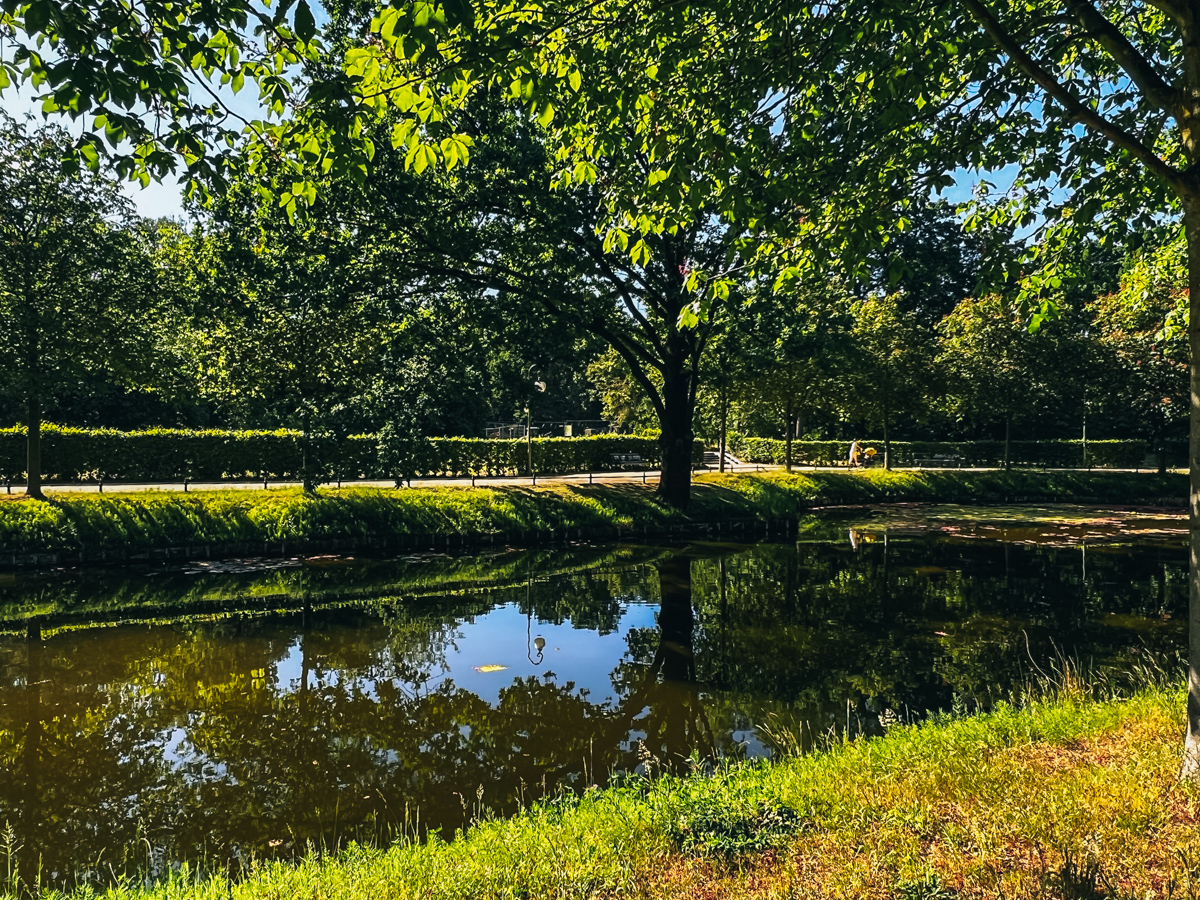
The 520 acres of the Tiergarten make up the oldest public park in Berlin. The Tiergarten began as a royal hunting grounds, then in the late 1600s Friedrich III, Duke of Prussia, declared it open to everyone – a “park for the pleasure of the general population.” You can relax here for a short time or spend longer sitting on a bench or riding a bike along the paths.
Look for the impressive Beethoven-Hayden-Mozart Memorial. When you get close, you can observe the bullet holes still in the marble from the battles of WWII.
The Tiergarten also is home to Zoo Berlin, the oldest and most visited zoo in Germany. Be sure to seek out the giant pandas
Learn more about the Tiergarten.
When you are ready to walk a couple of blocks, take this route to see the following sights.

Pay tribute at the Berlin Holocaust Memorial
From Potsdamer Platz, turn north on Eberstrasse and walk a short distance to find the Berlin Holocaust Memorial (at Wilhelmstrasse).
The memorial’s official name is Memorial to the Murdered Jews of Europe. It’s made of 2,711 plain cement blocks, or stelae, laid out in neat rows on undulating ground. Some are as high as 15 feet. You can get lost and feel like you’re in a maze. The disorientation is part of understanding what Jews suffered.
A visitor’s center under the field of stelae is dedicated to remembering those who lost their lives.
Learn more about the Berlin Holocaust Memorial.
Find the Statue of Liberty Berlin Bear
On the north side of the Holocaust Memorial, you’ll find the U.S. Embassy. It’s at Parisier Platz 2. And it’s worth finding because in the window you will see a Statue of Liberty Berlin Bear. These bears are scattered through Berlin, each with different colors or clothing or costumes. When I asked a local the meaning of the Berlin bears, he shrugged and said, “They are Berlin bears.” They are delightful to spot, and this one is especially fun.
Gaze at the iconic Brandenburg Gate
The Brandenburg Gate towers above the center of Berlin. When you think of this city, this is likely the image that comes to mind. It dates from 1791 and was modeled on the Acropolis in Athens. In recent history, the gate was damaged during World War II, then caught between the two sections of wall when the Berlin Wall went up. The wall was literally a few feet on either side of the gate, blocking passage. Now the ancient gate is repaired and open once again to the public. I passed by here every day of my Berlin stay, taking in the beauty and symbolism of this monument.

Tour the historic Reichstag
Across the street from the Brandenburg Gate stands the Reichstag, a massive building that today houses the German parliament and displays layers of history.
Completed in 1894, it housed the government for decades. In 1933, a famous fire destroyed part of the building shortly after Hitler became Chancellor. He blamed others for the fire and closed the building, insisting this entitled him to grab more power for himself. Perhaps he actually engineered the fire? No one knows.
During the liberation of Berlin in 1945, Russian troops rushed into the Reichstag, as it symbolized Germany. The building, damaged from WWII, wasn’t repaired by the Soviet occupiers. It wasn’t until after the fall of the Berlin Wall and the Communists left the city that the new, unified German government moved into the Reichstag and the interior of the building was modernized.
The floor of the parliament boasts about 600 blue chairs and a huge Bundestag eagle presides over the room. If you look up, you’re looking up into the glass dome that’s visible from outside.
The glass dome is a marvel of architecture and efficiency. Inside, as you wind up the circular structure, the views of Berlin are stunning. The lower end opens into parliament (no secrets allowed!) and the top end is open to the sky.
If you want to tour the inside of the Reichstag or go inside the dome, you will want to reserve a ticket. Check the website for current requirements. Sometimes tickets need to be obtained weeks before your visit. Currently you can visit the dome free of charge, but you must register before the day you want to visit.
Learn more about the Reichstag.
Find the Russian Memorial and tank
From the Reichstag, cross the street and enter the Tiergarten. On this side of the Tiergarten you will find the Russian Memorial and tank. These pay tribute to the Russian troops who liberated Berlin in April and May 1945.
 You can make your way through the Tiergarten to return to Potsdamer Platz.
Learn about the T4 Operation of WWII Headquartered here
Just a few steps around the corner from Potsdamer Platz is the T4 memorial. It commemorates the victims of the Nazi euthanasia program, known as Aktion T4, which aimed to exterminate people with disabilities and mental illnesses.
The T4 Memorial in Berlin is situated at Tiergartenstraße 4, near the Berlin Philharmonic and the Kulturforum at the site where the headquarters of the program was situated during the Nazi era. Here is a photo of the administration building that is no longer in existence.
The memorial consists of an information center and a reflective outdoor space.
Learn more about the T4 euthanasia program.
Learn about the fight for freedom at the German Resistance Memorial Center
Starting at Potsdamer Platz, walk about 15 minutes west to visit the excellent German Resistance Memorial Center.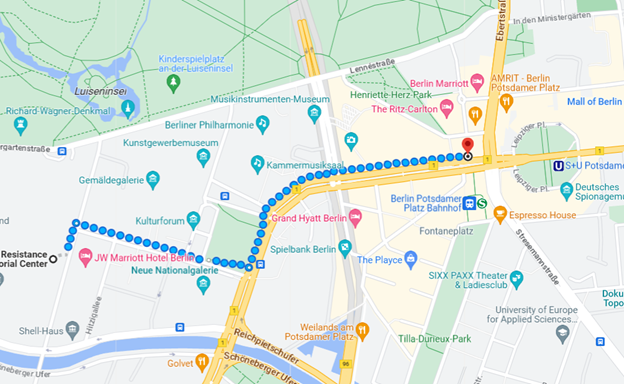
The courtyard, also known as the Bendler Block, is the site of the execution of officers involved in the attempt to assassinate Hitler on July 20, 1944, including the leader Claus Schenk Graf von Stauffenberg.
The Memorial Center’s permanent exhibition provides extensive documentation of the motives, aims, and forms of the fight against Hitler’s National Socialist dictatorship.
Learn more about the German Resistance Memorial Center.
Take a walking tour of the highlights of the Potsdamer Platz area of Berlin with the excellent company, Context Tours.
Restaurants near Potsdamer Platz
You are spoiled for choice if you want to eat near Potsdamer Platz. You can find anything from ethnic foods to coffee places to ice cream. Here are a few popular spots.
Vapiano Berlin: A popular Italian restaurant chain, Vapiano offers a casual dining experience with made-to-order pasta, pizzas, and salads. This is across the street from the transportation hub at Potsdamer Platz. The pasta sauce is delicious. I ate here with my husband, then introduced friends to this restaurant the next night.
Lindenbräu am Potsdamer Platz: A traditional German beer garden and restaurant, Lindenbräu offers a selection of German cuisine and its own brewed beer. It has a spacious outdoor seating area, perfect for enjoying a meal in a relaxed atmosphere. Try the German potato soup with fresh bread for a tasty lunch.
Pots Restaurant. Located in the Ritz-Carlton, Pots features displays and counters of gleaming copper pots. The food is varied and exquisite. And, as I ate here a few times, I must say the friendly service always surpasses expectations.
Vox Restaurant: Situated in the Grand Hyatt Berlin, Vox offers a contemporary dining experience with a focus on Asian cuisine. It features an open show kitchen and a stylish atmosphere.
Caffe and Gelato: This ice cream and coffee place specializes in artisanal Italian ice cream dishes. Only fresh, natural ingredients go into their creations. Head to Potsdamer Platz The Playce to enjoy a yummy treat.
Where to stay in Potsdamer Platz
There are several hotels near Potsdamer Platz in Berlin, offering a range of options to suit different budgets and preferences. Here are a few hotels that are in close proximity to Potsdamer Platz:
The Ritz-Carlton, Berlin: This luxury hotel, located right at Potsdamer Platz, offers elegant rooms, a spa, multiple dining options, a cigar lounge, and a rooftop terrace.
Stay at the exquisite Ritz-Carlton Berlin for its top-notch service and décor and central Berlin location.
The Mandala Hotel: This boutique hotel, just a short walk from Potsdamer Platz, provides stylish and spacious rooms, a wellness area, and a rooftop terrace with panoramic views of the city.
Stay at the stylish Mandala Hotel in Berlin and enjoy views of the city from the rooftop terrace.
Mövenpick Hotel Berlin: This hotel is located within walking distance of Potsdamer Platz and offers comfortable rooms, a restaurant, a fitness center, and a rooftop terrace.
Stay at the Movenpick Hotel Berlin and easily walk to the sights you most want to visit.
Grand Hyatt Berlin: This luxury hotel situated adjacent to Potsdamer Platz, offers well-appointed rooms, a spa, multiple dining options, and an indoor pool. I stayed here and especially enjoyed the breakfast. Book it the night before with the front desk.
Stay at the Grand Hyatt Berlin for modern decor, comfortable rooms, and to be within walking distance of major sites.

Book your train tickets with Rail Europe for easy and reliable service.
Rail Europe partners with more than 230 train services such as SCNF, DB, and Swiss train lines. So, you can always find the transportation you need for your trip.
Renting a car? I can recommend renting with Auto Europe.

Explore more places within walking distance of Potsdamer Platz
If you’re up for walking a little further, you can see more fascinating Berlin places, including:
The Topography of Terror
The site of Hitler’s Bunker
Museum Island
Berlin Cathedral
Berlin boasts a superb public transportation system, so it’s easy to plan your days. And be sure to include time for exploring Potsdamer Platz. Astounding historical places await!
Learn more about Berlin
Read these posts for more about Berlin:
Touring the Reichstag
The Berlin Cathedral
Berlin’s Topography of Terror Center
The Berlin Wall Memorial
Visiting the Berlin Holocaust Memorial
Relaxing in the Tiergarten
Exploring Berlin — 5 Favorites
PIN IT FOR TRAVEL PLANNING



Wonderful photography. Quite a complex history.