
Visiting Pointe du Hoc, Site of World War II D-Day Battle
Visiting Pointe du Hoc at the D-Day Beaches in Normandy is an unforgettable experience. What took place here on June 6, 1944, is a story of daring, bravery, and amazing feats. Standing on the battleground surrounded by craters caused by bombs, in the middle of the ruins of German cement bunkers, while you look out across the English Channel, you will hear the echoes of that long-ago battle.

 Allies landed at Omaha Beach, Utah Beach, Juno Beach, Gold Beach and Sword Beach on that Day of Days. Pointe du Hoc lies between what was Omaha Beach and Utah Beach in the Allied invasion of France known as Operation Overlord.
What’s so amazing for anyone visiting Pointe du Hoc today is that the scarred land remains much as it was on June 6, 1944. You can walk into the German Bunkers. You can view the gun emplacements. You can look east toward Omaha Beach and know it is right on the other side of the distant promontory.


Walkways and memorials have been added to the scene. As parts of the cliff-side area are unsafe, it’s important that you stay on the paths for safety.
But you can understand the lay of the land, descend stairways into German bunkers, look through slits in the stone and see exactly what the Germans saw as hundreds of vessels headed across the channel. Some landed exactly here. They carried men in the 2nd Rangers who disembarked onshore to carry out an unusual assignment.

Before visiting Pointe du Hoc, you will want to learn an overview of what happened on this windswept area on D-Day.
The Pointe du Hoc Battle
Atop a steep cliffs rising 100 feet from the beach here, the Germans built bunkers that housed 6 guns that could point directly at what is now known as Omaha Beach and Utah Beach. These 155-mm guns could have caused much damage on invasion day, June 6, 1944.
This map from the US National Archives gives a good picture of the location of Pointe du Hoc in relation to Omaha Beach and Utah Beach on D-Day. The Rangers took on their Operation Overlord assignment of landing on the beach at Pointe du Hoc and scaling the high cliffs. Once on top, they were to capture and disable the 6 large guns. Of course, German military would be guarding these.
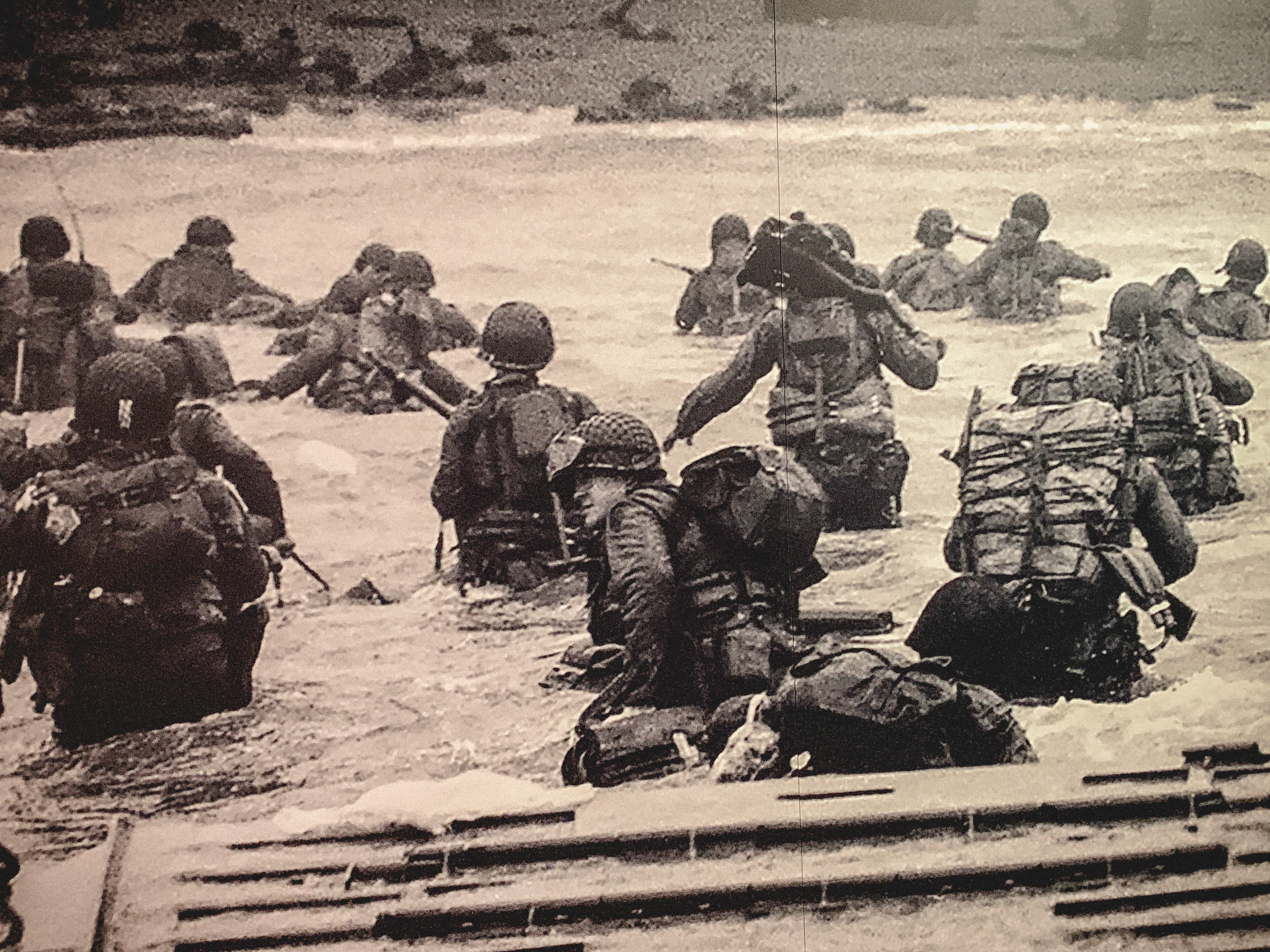
At 7:10 a.m. on D-Day, the Rangers, led by Lieutenant Colonel James Earl Rudder, arrived on the beach at Pointe du Hoc. Using rocket-fired grappling hooks and ladders, they scaled the cliffs under intense fire. Some grapples fell short or were cut by the Germans, but many Rangers managed to reach the top.
Where are the guns?
Once a contingent of Rangers scaled the cliffs, they made an amazing discovery. Although Germans defended the bunkers, the guns were not there. The Germans had moved them inland to avoid Allied bombardment. Some of the Rangers pressed forward through German resistance and explored the lanes and hedgerows. They were surprised when they located five of the guns about a mile away from the bunkers, sitting all in a row. Using thermite grenades, the Rangers put the guns out of action. The sixth gun was never found.
Here’s a photo from the US National Archives of General Eisenhower inspecting one of the disabled guns a few days after D-Day.

The next two days of battle, June 7 and 8, 1944
After completing their mission, the Rangers were heavily counterattacked by German forces. For two days, they held their ground on the narrow promontory of Pointe du Hoc with limited reinforcements and supplies. Their reinforcements had mistakenly landed on Omaha Beach and had to break out of that area to get to Pointe du Hoc.
Out of the original 225 Rangers who landed, only around 90 were still able to fight by the time they were relieved on June 8, 1944.
The Ranger Monument
You can see the Ranger Monument, given by the French, from a distance. It’s in the shape of a dagger, signifying that Rangers used daggers to help them get a foothold on the cliffs. Due to erosion of the edges of the land, paths have closed and been diverted. You may or may not be able to get close to the monument. Along the new path, new interpretive panels were installed in 2022. Stories of the courage of the Rangers enhance your visit.
Visiting Pointe du Hoc today
Today, Pointe du Hoc is preserved as a memorial to the sacrifices made during the D-Day landings. The site still bears scars from the intense fighting, with bomb craters and remnants of the German fortifications visible to visitors.
From the parking lot and visitors’ center, head right to the paved walkway. Stop to take a photo of this map so you can see where the walkways head. You can basically go in a circle and end up back at the visitors’ center.
Now you’re ready to explore this battleground and its history.
Exploring the Pointe du Hoc bunkers
 This is my favorite part of visiting Pointe du Hoc. You can actually enter these bunkers and stand where the Germans stood on D-Day. Some bunkers are partially damaged from Allied bombs, so stay where visitors are allowed for your safety.
One bunker is well preserved and has stairs to its roof. From atop this bunker, you can look all around and take in the English Channel, the coastline at Pointe du Hoc, the view north to the peninsula hiding Omaha Beach, and the many craters that dot the landscape around you.
I recently toured with the National World War II Museum in New Orleans on their Easy Company tour. The paratroopers of Easy Company, 101st Airborne, landed just inland from Utah Beach and Pointe du Hoc, so of course the tour spent the morning at Pointe du Hoc. And this was a highlight of my tour of the Normandy Beaches this trip.
An excellent local guide told us about what happened in the different areas of Pointe du Hoc. His name is Pierre-Samuel Natanson and he runs Normandy at War Tours. A guide can make the experience of being at Pointe du Hoc come alive, with personal stories of the soldiers and so much information.
If you want to look into a tour with the museum or a personal tour with Pierre-Samuel, I can highly recommend both!
You may notice that my tour group was standing in freezing wind on this high point about the English Channel. Even if it’s a sunny and comfortable day, take a windbreaker shell with a hood or some kind of warm hat. I wore a jeans jacket this day and nearly froze. You’ve been warned!
Notice the bases for the big guns
These bases where the guns had been are still here. You can imagine what damage 155-mm guns could have inflicted on D-Day when trained on Omaha Beach and Utah Beach. Allies can be thankful that these guns were moved shortly before the invasion.
President Ronald Reagan’s speech on the 40th anniversary of D-Day
On the 40th anniversary the D-Day, the President of the United States, Ronald Reagan, traveled to this windswept, crater-scarred barren land. Veterans of the assault on Pointe du Hoc sat behind him as he spoke.
“These are the boys of Pointe du Hoc. These are the men who took the cliffs. These are the champions who helped free a continent. These are the heroes who helped end a war.”
“Their mission was one of the most difficult and daring of the invasion: to climb these sheer and desolate cliffs and take out the enemy guns. The Allies had been told that some of the mightiest of these guns were here and they would be trained on the beaches to stop the Allied advance.”
“The Rangers looked up and saw the enemy soldiers — the edge of the cliffs shooting down at them with machine guns and throwing grenades. And the American Rangers began to climb. They shot rope ladders over the face of these cliffs and began to pull themselves up. When one Ranger fell, another would take his place. When one rope was cut, a Ranger would grab another and begin his climb again. They climbed, shot back, and held their footing. Soon, one by one, the Rangers pulled themselves over the top, and in seizing the firm land at the top of these cliffs, they began to seize back the continent of Europe.”
“Strengthened by their courage, heartened by their value [valor], and borne by their memory, let us continue to stand for the ideals for which they lived and died.”
If you are able to go to Normandy and the D-Day Beaches, include a visit to Pointe du Hoc in your itinerary. You will be honoring the champions who fought so bravely for the cause of freedom.
This post contains affiliate links. Clicking on them may result in a commission being paid if you purchase afterwards. This is at no extra cost to you. All opinions are always my own.
Getting to the D-Day Beaches from Paris
You have several options if you are traveling from Paris to the D-Day Beaches.
By train, journey either to Caen or Bayeux. Trains leave from the Paris Saint-Lazare station. The trip is about two to two-and-a-half hours.
Book your train tickets with Rail Europe for easy and reliable service.
Rail Europe partners with more than 230 train services such as SCNF, DB, and Swiss train lines. So, you can always find the transportation you need for your trip.
If you drive from Paris to Bayeux or Caen, allow about 3 hours. Take A13 to Caen or A13 and A84 to Bayeux.
I can recommend renting with Auto Europe

I’ve learned that the easiest way to get from Paris to Bayeux is to train to Caen, then rent a car. The car rentals are conveniently right across the street from the train station in Caen. Then drive about 20 minutes to Bayeux. I have driven from Paris, but driving in the city can be crazy. I actually went around the Arc de Triomphe in a circle several times before finding the right exit street. And I haven’t wanted to repeat that adventure!
Where to Stay Near Pointe du Hoc and Omaha Beach
To stay near the Pointe du Hoc and Omaha Beach (or any of the D-Day Beaches), you can stay in Bayeux as your base. Bayeux is a charming town in Normandy, France, known for its well-preserved medieval architecture and its famous Bayeux Tapestry. It’s also the closest town to Omaha Beach. I have stayed here and loved the town, the food, and the people.
When staying in Bayeux, you have various accommodation options ranging from hotels to guesthouses and bed-and-breakfasts. You may want to opt for a hotel in the city center. That way, you are close to the sights as well as plenty of dining and shopping choices.
My favorite hotel is the Hotel Churchill. It’s in a historic building in the heart of the town. It offers comfortable and well-equipped rooms, with amenities like free Wi-Fi, flat-screen TVs, and private bathrooms. Some rooms may offer views of the city or the courtyard. And the hotel has a bar and lounge area where guests can relax and unwind. A tasty breakfast is served in a pleasant room. I found the front desk staff to be very helpful with planning your day and finding a restaurant for dinner.
Book the elegant Hotel Churchill — the perfect base for exploring the D-Day Beaches.
Learn more about the D-Day Beaches in Normandy
Visiting the D-Day Beaches: Utah Beach
Visiting the D-Day Beaches: Omaha Beach
Visiting the Five Normandy D-Day Beaches
Visiting the D-Day Beaches: Gold, Juno and Sword
Riding a Jeep Through Normandy
Learn more about Normandy
The Old Harbor of Honfleur
Reasons to Visit Normandy France
Reasons to Visit Bayeux France
Tour the American D-Day Beaches as part of tracing the path of Easy Company in WWII with the National WWII Museum.
PIN IT FOR LATER!!!





Great write up. I’ve visited Normandy twice; Omaha and Utah beaches, the American and German cemeteries, and the museum in Caen. I need to get back and see Juno, Gold, and Sword beaches. We tend to Americanize the entire thing while it was very much an enterprise of Allies. Recognizing that does not demean or disrespect anyone, I believe it gives us hope that good humans can pull together to defeat the bad.