Flossenburg Concentration Camp Memorial – A Place of Remembrance
Flossenburg Concentration Camp was one of the hundreds of camps run by the Nazis during World War II. It’s set in the lovely forested land of eastern Germany, just a few miles from the Czech Republic. This camp was opened as a satellite camp to the well known Dachau Concentration Camp. A ruined castle sits atop a hill overlooking the camp, adding to the picturesque yet chilling atmosphere.


A brief history of the founding of the Flossenburg Concentration Camp
The Flossenbürg camp opened in May 1938 during the German SS reorganization of the entire concentration camp system. In the new system, the purpose of the camps was no longer just to imprison political opponents of the Third Reich. It was also to profit from prisoner labor.
Why Flossenburg was chosen as a concentration camp site
The attraction for the German war machine was the large granite quarry here. As the war went on, more and more prisoners from virtually every country in the European theater of the war were sent here to wrest granite slabs from the earth.
Flossenburg Concentration Camp is now a memorial
Today, the quarry still produces granite, while the nearby camp is a peaceful memorial to those who died here. 


Visiting the Flossenburg Concentration Camp Memorial
The Flossenburg Concentration Camp Memorial welcomes visitors. If you wish to go and pay your respects to the many who lost their lives here, you will be moved. While it is a sobering place to be, the focus is on honoring the camp victims by name and photographs. You will see the wartime administration building, a museum in one of the original buildings of the camp, a lovely memorial chapel, the crematorium, and respectful representative gravestones.
The main building at the entrance of the camp
The main building survived and now houses a team of researchers and administrators. They are involved in actively finding and naming prisoners and survivors. 
 We were given the honor of spending a full day with these researchers because my dad served in the camp right after the war. He was with the 90th Army, nicknamed the Tough Hombres. Here’s a plaque we found on the grounds thanking the 90th for their part in the camp’s liberation.
Read more about my dad’s WWII story and my journey to trace his footsteps.


The chapel, the mass grave, and the guard tower
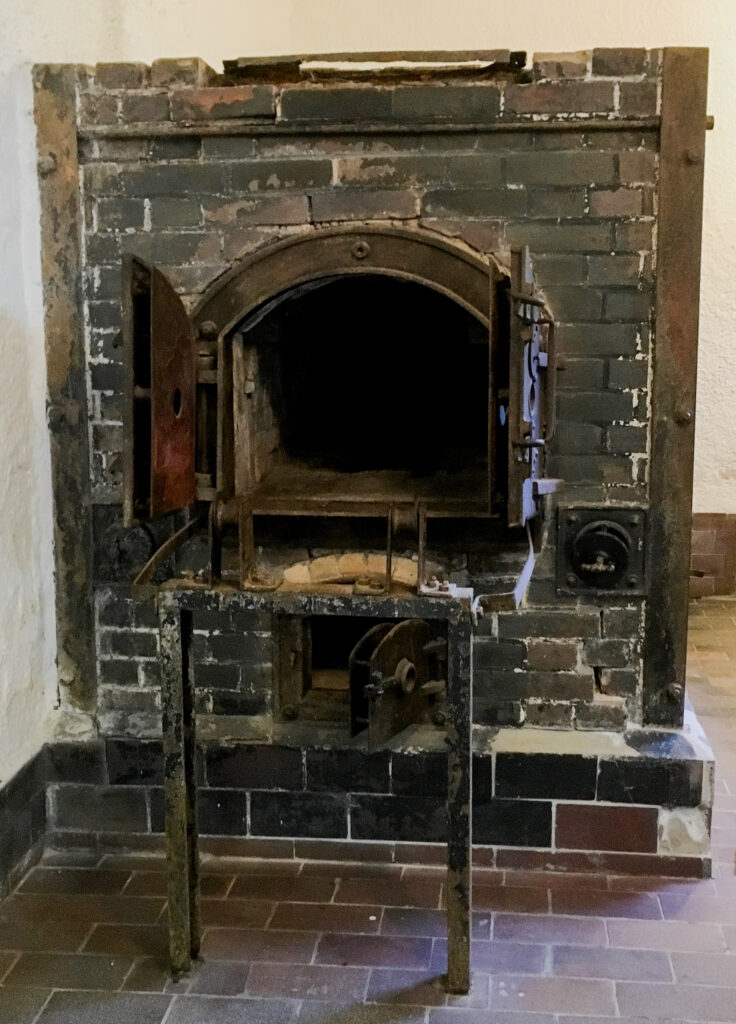
With Annabelle and Tamara, we toured the gardens. We went in the memorial chapel with its lovely stained glass. We paid respects at the mass grave. We stood in the shadow of the guard tower and somberly entered the crematorium. 


The museum to honor the victims of Flossenburg Concentration Camp
One of the surviving original buildings houses a museum that pays tribute to individuals who lost their lives here. The numbers are staggering – about 30,000 dead – but numbing. Once you put a name and a face with a number, you can begin to understand the horror of Flossenburg. 


The site of the execution of theologian Dietrich Bonhoeffer
Flossenburg is the camp where theologian Dietrich Bonhoeffer was killed just before the war’s end. He died because he participated in the attempted assassination of Adolph Hitler in July, 1944. We walked along the wall where he was executed. 

The liberation of Flossenburg Concentration Camp
The quiet of the forest surrounding the camp must have been such a contrast to the life of the prisoners. As the Allies approached in April, 1945, the German guards took all prisoners who could stand on a death march. They left only the sickest behind. Allies liberated the camp on April 23, 1945.When my dad arrived in July, 1945, about 1,500 ill souls were still there. In the museum, we found this photo of some of those men.

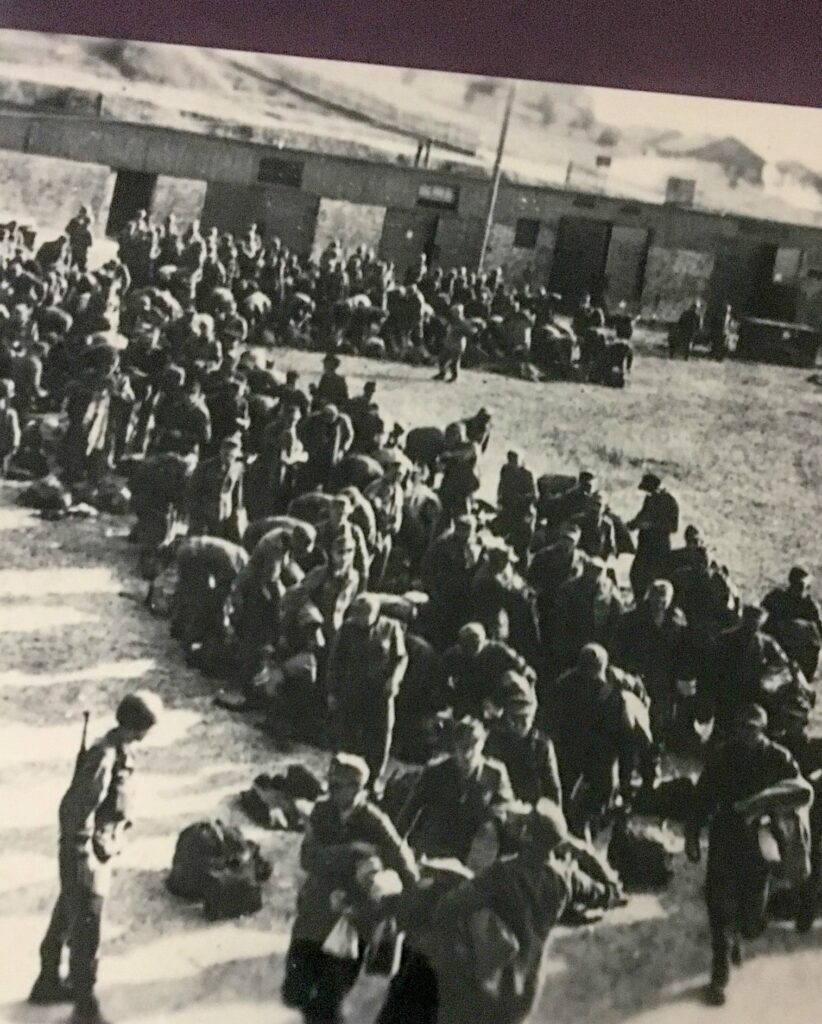
From July 1945 to April 1946, several thousand German SS troops were kept in Flossenburg’s barracks. Here’s one of the first groups to arrive. As this coincides with my dad’s arrival at the camp, he could have seen this exact scene.
Ongoing research to honor the victims of Flossenburg Concentration Camp
For about 50 years after the war, Flossenburg stood as a only a mass grave. Most of the buildings were torn down for construction material. Relatives of prisoners and other caring people finally organized to develop a fitting memorial. The work is ongoing. It was an immense privilege to learn from these young scholars a more detailed history of Flossenburg. The years pass, but we remember what happened here. For the sake of our humanity, we must never forget. 


This post contains affiliate links. Clicking on them may result in a commission being paid to us if you purchase afterwards. This is at no extra cost to you. Thanks.
Planning your visit
For more information, visit the memorials website. The museum and camp area is free and is open every day from 9:00 a.m. to 4:00 p.m. in December through February. From March through November it is open from 9:00 a.m. to 5:00 p.m.
Where to stay when visiting Flossenburg Concentration Camp Memorial
Flossenburg is a small town without many options for staying overnight. I chose to stay in Nuremberg, which is about an hour’s drive west. And this larger city is replete with hotels and restaurants. Nuremberg also makes a perfect base for sightseeing in this area of Germany. A day trip to charming Rothenberg is easy, as well as a day trip to Flossenburg.
My favorite place to stay in Nuremberg is the Hotel Elch, in the heart of the old town, just steps from the castle. Book early, as they tend to fill up!
Book your train tickets with Rail Europe for easy and reliable service.
Rail Europe partners with more than 230 train services such as SCNF, DB, and Swiss train lines. So, you can always find the transportation you need for your trip.
Renting a car? I can recommend renting with Auto Europe.


PIN IT FOR LATER!! 




Haunting… and powerful. It seems so peaceful today, but with that history…
Excellent photos.
Have to look up Flossenburg’s location, because we have friends since the 70ties in S-Germany (when it was still communistic), close to the Czech republic. It never fails when I see images of the concentration camp areas I get teary eyed. We have lived in Berlin, a wonderful place with Germans who became friends, I can only understand it (a little) as God’s scales of justice working when so many awful things happen in one country (comparative to other Eur. countries).
Thank you Sharon for bring this to All Seasons’ attention. Because your father was serving here, it belongs to your family history. Thank you for sharing!!
Sobering to think how cruelly we treat our fellow human beings. How terribly sad.
Thanks for sharing at http://image-in-ing.blogspot.com/2019/01/bloomin-beauty.html
Another great post on a sad subject – so much violence and death. We can never forget.
I do so hope that we never forget!
I’ve visited a few of these camps and it is a sobering feeling. This one looks like a lovely memorial.
I’d never heard of the Flossenburg camp before, so thank you for introducing me to it and it’s history. How very sad, were they quarrying the granit for rebuilding efforts during the war? It must have been surreal to be there when you had such a personal connection to the place. #WanderfulWednesday
Heartbreaking that such terrible things can happen in such a beautiful setting
What a somber and sobering place. The history is so horrible but the memorials are such a loving tribute. Thanks for sharing your photos and your impressions of this place.
Beautiful, serene photos – a wonderful tribute to a terrible place. I do love the stained glass – it seems quite fitting. I’ve not been able to visit one of the camps because of the overwhelming emotional impact that I feel it would have. I think that seeing it through the eyes of others, thoughtfully as you have done, is the first step to finding the courage to confront the past though.
A very touching post and so important that we visit these places and never forget. Thanks very much for sharing #farawayfiles
Thank you so much for writing this post. I consider myself very knowledgeable about WWII, though hadn’t heard of this camp. It’s important these things are shared.
#FeetDoTravel
I couldn’t agree with you more about sharing and visiting places like these. It’s so important to keep the memories alive to prevent this from happening again even if it is so incredibly sad. Fascinating that your family has a connection to this place, it must have made the visit even more moving for you. Thank you for sharing on #farawayfiles
I got goosebumps reading this – there’s such a contrast between the beautiful countryside and the horrors that happened at the camp. I’ve just been reading a book called ‘The Lilac Girls’ based on a true story and some of it focuses on Ravensbruck Camp – as you say it’s so important that these places are visited and the stories are still told. We went to Auschwitz and it was a really heart wrenching experience but one I will never forget. How amazing that your dad had such an important part to play here – but how hard it must have been too. I’ve been watching a documentary series called ‘After Hitler’ – giving a fascinating insight into what happened after the camps were liberated.
I find visiting concentration camps is so emotionally draining, but it also feels like a necessary duty to pay homage to the poor people who were interned. This sounds like a particularly interesting and emotional visit for you as your dad played a part in the liberation – it must have been so eye opening. I’m glad you were able to see it for yourself!
This was a great read. I didn’t realise that Flossenburg was still in existence – for some reason it doesn’t get mentioned on the same level as Dachau, Mauthausen or Sachenhausen in the concentration camps. It must have been particularly interesting with your father playing such a role. The things he must have seen.
A very powerful post about why we need to remember what happened here. Seeing all of the plants and flowers growing around the graves and the site made me think of how we can heal after a traumatic incident. Thank you for sharing your story and reminding us of the understanding we can gain from visiting a place like Flossenburg. #WeekendWanderlust
What an emotional visit this must have been, Sharon! You are right, we need to remember this dark part of history, so hopefully, we won’t ever repeat it. It’s good that they made it into a museum, and trying to find everyone’s name who suffered there, so they may be honored.
So many different stories of remembrance you are having as your honour your Father. We need to be reminded of the past in order to not repeat mistakes in the future (although often I fear we don’t learn … I say this as I have just written my post on the Cambodian Genocide). Such a lovely setting for a place so horrible. Pinned for others to share. #feetdotravel
I’ve toured the battle sites in Normandy and the American cemetery (where I think every American should visit) but I’ve not been to a site of a former concentration camp. It must bring up so many emotions – and the fact that your father was here would add to that. What a touching post.
What a special and humbling experience to have been able to spend the day with the people doing such important work here. Thanks for sharing on #FarawayFiles
You are so right that the numbers dead make it hard to process – until you find a name or a photo to make it all real. Interesting and sobering post.
What a privilege to visit the camp where your dad had served after the war. It’s reassuring to know that research continues and the terrible atrocities that happened here will never be forgotten.
#farawayfiles
Heart touching article. Thanks for sharing such a valuable article.
Dear Sharon, Thank you for sharing this website with me, I too, like your Dad, witnessed the liberation day, April 23, 1945 as a member of the 90th Division. My family and I have been back 6 times to visit the transition from a place of despair to a treasured display of
beauty and dignity. Two people stand out who played a very large part in what you see on a visit, Dr. Jorg Skreibeleit, the Director,
and Dr. Jack Terry, a former inmate, both very dear friends of mine. You have done a great service to all who will visit your website.
Vern Schmidt
I was a soldier in an intelligence unit deployed to Rotz area in 1965 or so and I later learned that a concentration Camp site was abandoned near our barracks, perhaps a branch camp of Flossenberg. I also learned later when working in Houston tX that a co-worker had served in the Tough Hombres unit in WW II. He was Lou Larrey.
Bill Reed
Hi, Bill — Thank you for your interesting comments. It’s likely the abandoned camp near Rotz was a branch of Flossenburg or another branch of Dachau (even though that’s pretty far). There were so many camps all over that area and Poland. Sounds like you had a fascinating job in Germany. I appreciate you sharing your experiences. Sharon
Thankk you for your post that I just read – I had the priviledge of visiting this camp for the 2024 commemoration of its liberation and went there to honor my uncle Marcel Marmillot a french Resistance member who was captured in 1944 after retrieving a weapons airdrop from Britain – He was arrested by the French gendarmes who collaborated with the Nazis and then handed over to the Gestapo who tortured him as was the practice and sent him to first Dijon prison, then Besancon France from where he was put on a train with others and was sent to Dachau and then Flossenburg where he died like so many others. We knew nothing about him until I started doing research and contacted the archive experts at the memorial site – May his name be remembered as well as each of the victims and inform all of us that we should never allow this behavior again regardless of political differences within the US and everywhere