Visiting Culloden Battlefield in the Scottish Highlands
The preserved battlefield at Culloden in the windswept moors and rolling hills of the Scottish Highlands is definitely worth a visit. The Battle of Culloden is significant in Scottish history. It was the final and most decisive battle of the Jacobite Rising of 1745. The Jacobites wanted to restore the exiled Stuart family to the British throne, but their hopes were dashed after this disastrous battle.
You can walk the battlefield paths, see the memorial cairn and clan grave markers. The excellent Visitor Centre explains the Jacobite Rising and the battle through immersive exhibits. The Culloden Battlefield is managed by the National Trust for Scotland and is a tribute to Scottish nationalism and Highland clan history.
Read on to learn more about why you will want to include Culloden in your Scottish itinerary. And what you will see when you tour this peaceful place.
The atmosphere of Culloden Battlefield
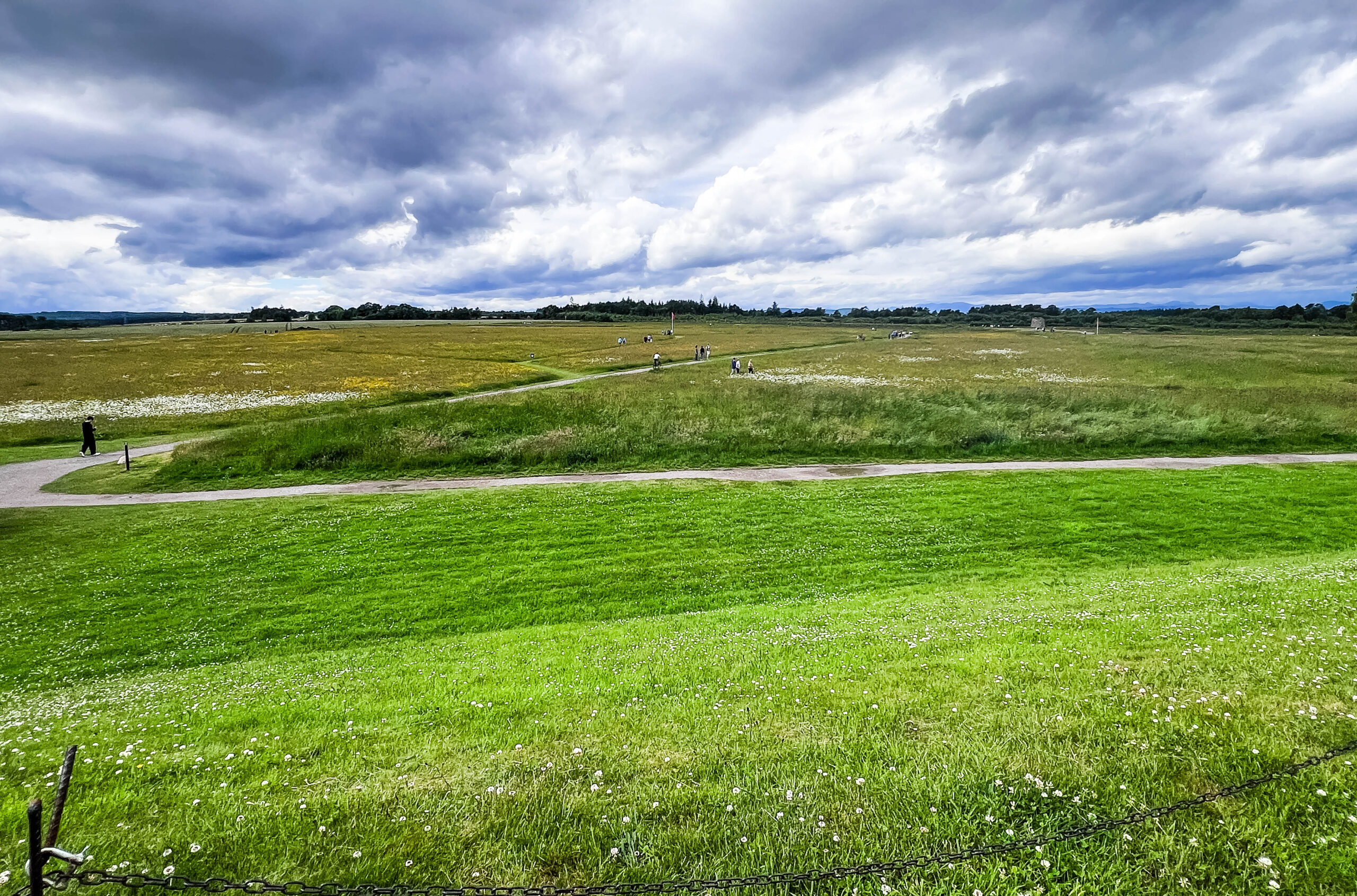
Today, the landscape remains remarkably similar to how it appeared in 1746. Walking the battlefield, you can still see the open moor stretching in every direction, making it easier to imagine the opposing armies facing one another across the Drumossie Moor. Heather and grasses blow gently in the wind, as they did on the day of the battle long ago.
One of the striking aspects of Culloden is its atmosphere. Unlike many battlefields that have been overtaken by modern development, much of the moor has been preserved. The combination of the open landscape, the often-changing Highland weather, and the simple clan memorial stones give the site a quiet, reflective feeling that many visitors find deeply moving.
Walking Culloden Battlefield
You will follow marked paths across the actual battlefield. The landscape is intentionally kept open and undeveloped, making it remarkably like it appeared in 1746.
You will first notice the red flags and blue flags waving above the moor. These mark the placement of the troops on each side in the battle. About 5,000 men fought with the Jacobites (blue flags). These were mostly Highland troops loyal to Charles Edward Stuart. The Government army (red flags) was made up of about 8,000 professional soldiers commanded by Prince William Augustus, son of King George II.
As you walk, notice how close the lines were to each other. It’s surprising how small the battle area is. You will understand why the carnage was so great in this clash. In less than an hour, about 1,600 men died; 1,500 of them were Jacobites. Scottish clans were decimated in this disastrous battle.
You will see many clan grave markers. 

These simple stones with etched words almost unreadable mark the mass grave of some of the clans in the battle. Look for:
- Fraser
- MacGillivray
- Cameron
- MacLean
- Chattan
- Macintosh
Amid these clan markers stands a large memorial cairn.
Erected in the 19th century, it commemorates those who died in the battle.

The Leanach Cottage is a restored 8th-century house that stood during the battle. It is one of the few surviving buildings from that day, thus providing a tangible connection to the events of 1746.
The Visitor Centre
The Visitor Centre at Culloden offers many experiences. If you have time, take in the museum and the introductory film before touring the battlefield. I had to skip this, but I wish I could have stayed longer and seen more of the Visitor Centre. Here’s information about what is available.
The museum at Culloden Battlefield
The museum is arranged almost like a story, following both sides of the conflict. It covers why Bonnie Prince Charlie launched the Jacobite rising and why the Highland clans joined him. You will learn how both armies arrived at Culloden Moor.
Original artifacts displayed include muskets, swords, pistols, and uniforms.
The theater presentation
A 360-degree film places you in the middle of the fighting, with soldiers charging from opposite sides while sound effects surround you. It lasts only a few minutes but is extremely effective and often quite emotional. Many visitors describe it as the highlight of the museum.
The roof garden
Before heading outside, spend a short time on the Visitor Centre’s rooftop viewing area. It gives an excellent overview of the Culloden Battlefield and helps orient you before your walk.
If hunger strikes during your visit, the Visitor Centre offers a cafeteria with tasty food. And plan for a stop in the gift shop to pick up a souvenir of your visit. My friends came away with shopping bags, hats, jewelry, and gifts to take home to family.
Consider a guided tour
For a modest additional fee, National Trust guides explain:
- Exactly where each army stood
- How the Highland charge unfolded
- Why the Jacobite line collapsed so quickly
- Key moments that are difficult to understand from signs alone
The tour guide who accompanied my Scotland trip served as the guide for my group. It does help to have someone explain about the battle as you tromp around the battlefield.
How long to allow for your visit
I would recommend spending about 2 hours for most visitors. Plan for 3 to 4 hours if you are a history buff. You will enjoy reading museum exhibits, listening to audio presentations, and walking the battlefield slowly.
The battlefield is open daily from 9:00 am to 5:00 pm.
Where is the Culloden Battlefield?
Culloden is in the Scottish Highlands about 5 miles east of Inverness. It’s an easy 15-minute drive to the battlefield from Inverness.
A brief historical background of the battle at Culloden
The battle occured because after the 1688 “Glorious Revolution,” the British removed the Catholic Stuart kings from the throne. Supporters of the Stuarts were called Jacobites (Latin for James).
In 1745, Charles Edward Stuart, often called “Bonnie Prince Charlie,” landed in Scotland with a plan to reclaim the throne for his father, James Francis Edward Stuart. Highland clans rallied behind Prince Charlie. They captured Edinburgh. They marched into England. The tide turned against them, though, and they retreated to Scotland.
The final battle in the struggle took place on April 16, 1746, near Inverness in the Scottish Highlands, at Culloden.
The day of battle
The Jacobites arrived at the battlefield moor where the British troops were dug in. Exhausted after a long march and hungry, the Jacobites were at a disadvantage. They tried their usual tactic of rapidly advancing with swords and shields. But Cumberland’s British army fired musket volleys and artillery and soon broke Jacobite lines. Within an hour, the Jacobites were roundly defeated.
Consequences of the Battle of Culloden
The battle changed life in Highland Scotland. Besides clans decimated by Cumberland’s army, the Scottish were forbidden to carry weapons. They could no longer wear Highland dress such as tartan fabric and kilts. Their Gaelic culture was suppressed.
Culloden is more than a historic battle. It is symbolic of the end of the old Highland way of life.
What happened to Bonnie Prince Charlie?
Prince Charlie fled and went into hiding for 5 months while government troops searched all over the Highlands for him. He hid in caves, slept outdoors, and was helped along by Highlanders loyal to the Jacobites.
The most famous incident was when young Flora MacDonald helped Charles escape from the Outer Hebrides by disguising him as her Irish maid, “Betty Burke.” Together they crossed the sea to the Isle of Skye. The event is commemorated in the well-known Skye Boat Song.
Charles eventually made his way to France, never to return to his beloved Scotland. Today, he is remembered less for his failures than for the dramatic adventures of 1745 and 1746. His story remains one of the most famous episodes in Scottish history, blending courage, loyalty, tragedy, and romance.
Culloden remains deeply important in Scottish memory and identity. The stark simplicity of this Scottish moor, combined with the in-depth interpretations in the Visitor Centre, give the site a powerful emotional impact. Visiting Culloden Battlefield will give you an understanding not only of the military events here but also the human cost and lasting impact of one of Scotland’s most defining moments.
About The Skye Boat Song
The well-known Skye Boat Song is a lament for the Scottish Highlands, a celebration of courage and loyalty, and an evocation of Scotland’s rugged beauty and tragic history. The lyrics are filled with sorrow over the Jacobite defeat at Culloden Battlefield in 1746, admiration for Bonnie Prince Charlie, longing for the lost Highland world, and hope during danger and exile.
You can listen to a lovely rendition of The Skye Boat Song and follow along with the story of Prince Charlie and his escape to Skye.
A famous line from the song is: “Carry the lad that’s born to be king…” This reflects the Jacobite belief that Charles Stuart was the rightful king in the struggle with the British monarchy in the 1700s.
Although the melody of The Skye Boat Song sounds ancient, the modern lyrics were written in the 1800s by Sir Harold Boulton. The tune itself came from an older Gaelic rowing song from Scotland. Over time, the song became less political and more symbolic of Scottish nationalism.
Today, many people know The Skye Boat Song from tourism, folk music, or the TV series Outlander, which adapted the melody for its theme song.
Flora MacDonald’s beautiful gravesite
If you listen carefully to the lyrics of The Skye Boat Song, you will hear mention of “Flora,” she who saved Charles by arranging the escape boat. And if you are taking a scenic drive through the Highlands along the A855 around the Trotternish Peninsula, you will find Flora’s grave in Kilmuir Cemetery. She died in 1790. Her grave is marked by a tall Celtic cross erected by her grandson when the original marker fell in 1880. I found that standing at her grave gave me a tangible connection to this remarkable woman of the Jacobite era. Her courage and compassion became legendary throughout Scotland.
The cemetery is amazing to see, with its Celtic crosses and panoramic views of the moors below.

Is a visit to the Culloden Battlefield worth your time? Definitely! You will find a deeper knowledge of Scottish history and culture and an emotional experience you will long remember.

PIN IT FOR LATER!